Emotions
 Learning Intention
 Background Info
 Student Activities
Student Learning Objectives
To build understanding that:
- Emotion words can label low and high energy feelings.
- Emotion words can label pleasant and unpleasant feelings.
- Pleasant emotions are helpful to how we feel and function.
- Our emotions can help us make wise behaviour choices.
- We understand emotions in the world around us by what we experience, for example: we watch tv, movies, dance, other people’s behaviour, we hear music, voices, sounds of nature, we touch, we smell, we feel in our hearts happiness, sadness, anger, grief, surprise and disgust.
- We communicate our own emotions by expressing how we feel in different ways: language, tone of voice, body language, dance, music, art, actions we take.
Teacher
Key take away messages:
- Emotions provide us with information about how we feel physically and emotionally, and help with decision making.
- Emotions are tied to multi-sensory, multi-model experiences and expression.
- Pleasant emotions are beneficial to how we feel and function: positive emotions open our awareness, enhance our creativity, increase resilience and potentially improve academic performance.
Research and shared knowledge.
Broaden and Build theory of positive emotions.
Barbara Fredrickson describes the ‘Broaden and Build’ theory of positive emotions, which explains the benefits of positive emotions for people, including opening our minds and expanding our perspective, and our hearts, enhancing our empathy (video 8:27mins)
https://www.youtube.com/watch?time_continue=1&v=Z7dFDHzV36g
Humans experience many different emotions and it is important to be able to identify and articulate emotions in oneself and others to communicate effectively. While emotions and emotional vocabulary may vary between cultures, the following article is an interesting place to start, thinking about some of the different emotions experienced in a western culture.
Some researchers have found categorising emotions is helpful to thinking about and understanding emotions. We categorise emotions as high energy or low energy, and as pleasant or unpleasant. Here is an interesting TED talk by Marc Brackett from Yale University about categorising emotions (video 17:29mins)
Student
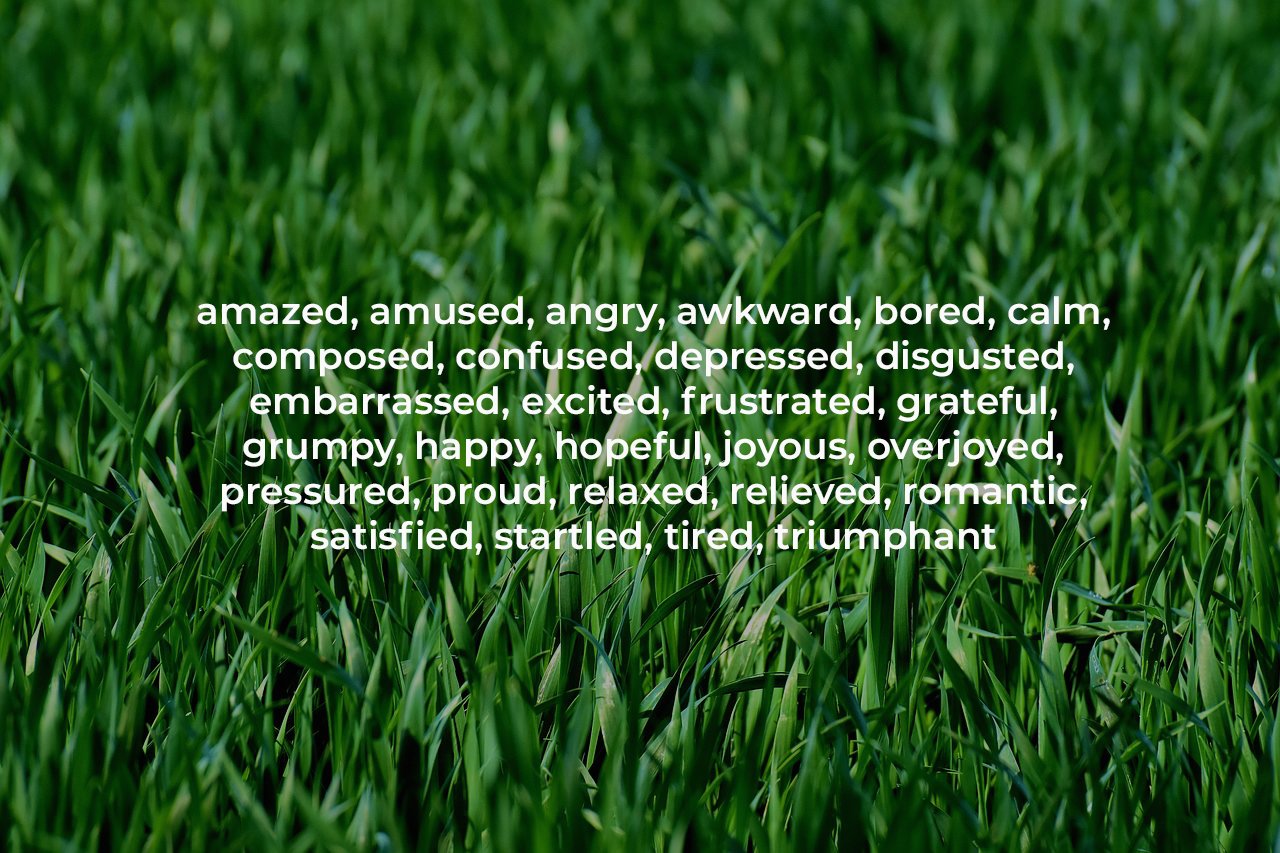
Find a new emotion vocabulary word, from the list or from a dictionary.
Try to use this word three times today.
In groups of two or three spend one minute brainstorming vocabulary for as many emotions as you can think of. On sticky notes write the vocabulary you know, consider high and low energy emotion, and positive and negative emotions.
Ready, set, go!

In small groups fill the map with as many emotions as you can think of – place them where you think they should go.
Create a picture representing an emotion of your choice.


Emotion art thanks to Bourchier Street Primary School, Shepparton, Victoria.
Excited is like pop-corn popping.

Choose an emotion and write a simile for it.
Emotion simile thanks to Western Melbourne Primary school students.
Metaphors are a cool way to communicate. Authors often use them in their writing to add detail and depth to their work. Metaphors work really well to communicate physical and emotional feelings.
While a written simile uses ‘like’ – excited ‘like’ pop corn popping.
A metaphor reads as if it were true. For example if you are happy: “I am the sun, I am the light, I
am the rainbow dancing in the sky.”
Here are some of the metaphors we came up with…there are many more…


Write – Metaphor rocket writing
Rocket writing. In groups of two or three, write onto sticky notes as many metaphors for as many different emotions as you can in 5 minutes. Use a new sticky note for each emotion.
The Red Tree by Shaun Tan is a book of metaphors
In this book, emotions of the main character, a red haired girl, are represented visually by Shaun Tan.
View the story here.
Here we see many emotions. At one time we see a dark sky and hard rocky shore, the girl with a scuba dive helmet on is crouched at the bottom of a bottle, reminiscent of a message in a bottle sent by a person lost and isolated on an island.
This is a metaphor for the emotion the girl feels. Remember a metaphor represents something as if it were true.
For example, we could translate the images as follows:
|
What we see (the visual metaphor) |
What it could mean, spoken aloud |
|
The child sits inside a bottle, the child is a message in a bottle |
I am lost |
|
The child wears a scuba dive helmet and is trapped in a bottle |
I am emotionally stuck, separate to the rest of the world and I feel alone and lost. |
What other metaphors can you spot in this story? Watch and make notes with a friend.
View and Create – Visual metaphors
Create your own visual metaphor!
Visual metaphors thanks to Lila, Baxter, Josh, Monty and Sam.
Talk – Positive emotions and creativity
Positive emotions can help us to open our heart and mind. They help us to be creative. Share with a partner a time that you experienced positive emotions before, or during a time you were creative.
Talk – Positive emotions and connection
Positive emotions can help us to open our heart and mind. They help us to connect to others. Share with a partner a time that you experienced positive emotions before, or during a time you felt connected to others.
Think, pair, share: think about the answers to these questions, share your thoughts with a partner. Combine with another pair and share your thinking.
What do you know about emotions?
What do you know about messages in emotions?
What do you know about emotions and feeling good?
What do you know about emotions and doing well?