Perspective
 Learning Intention
 Background Info
 Student Activities
Student Learning Intentions
- Understand that viewing a situation from a different perspective can be helpful,
- Practice viewing situations from different perspectives,
- Understand that our thinking choices effect how we feel and act,
- Apply a ‘growth mindset’ approach,
- Apply the ‘thinking like a detective’ strategy,
- Avoid thinking traps such as ruminating.
- Practice gratitude.
- Practice noticing what went well.
Teacher
Key take away messages:
- A flexible and responsive nervous system can be calmed and controlled by thinking choices, such as mind based strategies, where we consciously choose to think and behave in a helpful way.
- There are a range of helpful thinking choices to help balance the nervous system
Research and shared knowledge.
People with a growth mindset tend to be open to growth and alternative perspectives. When confronted with a challenge, they may seek a solution, rather than think the solution is not possible. People with a growth mindset may embrace mistakes as learning opportunities.
https://hbr.org/2016/01/what-having-a-growth-mindset-actually-means
Rumination is when we go over and over and over a bad thing that happened to us. It is often unhelpful to keep the mistake or the problem on a continuous loop in our head. For a student, if it is a big problem then they may need to share their problem with a trusted adult. If it is a smaller problem, it may be a problem that needs to be left to rest. What we focus your mind on can effect how you feel. We can ask ourselves: ‘Is this helpful to be thinking this way?’. If it is not helpful then you might change what you are focused on.
https://www.rickhanson.net/teaching/tgc-public-summary/
A person with flexible accurate thinking is open to seeing a situation from another person’s perspective.
Bad can be stronger than good, this is called negativity bias.
Humans have evolved like this in order to avoid bad or dangerous things happening to them, consequently it can take 3 or 4 or 5 good experiences to out-weigh one bad experience!
Positive thinking can help overcome our natural inclination to focus on the negative.
Student
What could be happening here? Brainstorm possibilities with a friend.
Picture a friend walking past not noticing you.

Alternative perspectives – Old woman or young woman?

Leeper, R. and Boring, E, 1930. “A New Ambiguous Figure” American Journal of Psychology, 42, 444
Alternative perspectives – Rabbit or duck?

Originally from Malach, Levy, & Hasson, 2002.
Alternative perspective – accident or deliberate?
Do these cartoons remind you of an experience you have had?

Mind based strategies – helpful thinking – Look at the positives.
Positivity, Gratitude, Kindness
Positivity, Gratitude and Kindness wall (Michael Masters Grade 5 teacher)

Initially I introduced the concept of positivity as a way of training our brains to focus the positive things in our life rather than the negative, which is what we tend to focus and dwell more on, so at the end of the day we would reflect on what went well using the prompts “Today went well because…….. and that made me feel……”
Then I introduced the concept of gratitude as a way of moving away from the ‘If/Then’ mentality (if I get this, then I will be happy), so we would reflect on moments where we truly felt grateful to have something in our lives. Structure of this can vary, but generally it is “Today I was grateful when…… because…….” or “Today I……. and this made me grateful because…….”.
We introduced a number of initiatives throughout the school to promote kindness, so this became a focus point also, where students are able to name others for being kind to them, eg “Today ….. was kind when they ….. and this made me feel ….”. We also introduced some kindness cards that move around the class where students need to actively pursue random acts of kindness.

Coming soon
What does a person with a growth mindset say?

Lucy video Mind based strategies – helpful thinking – avoid thinking traps.
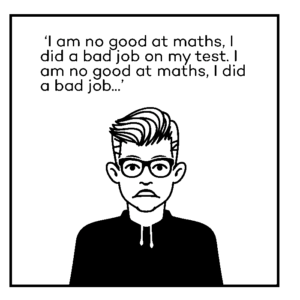
Rumination is when we go over and over and over a bad thing that happened to us. It is often unhelpful to keep your mistake or your problem on a continuous loop in your head. If it is a big problem then you may need to share your problem with a trusted adult. If it is a smaller problem it may be a problem that needs to be left to rest.
See the cartoon below…what would be more helpful self-talk?